

How Long Should a Coaching Book Be? Pages, Words, and KDP Spine Width
In 1997, James Clear was eleven years old. Atomic Habits would not exist for another two decades. When he finally published it in 2018, the book ran 320 pages, not the 500-page encyclopedia his subject might have justified. Clear edited obsessively, cut whole chapters, and kept only what a reader needed to change behavior. The result sold 15 million copies. Every coach who has ever held a copy has wondered, consciously or not, whether their book should be that long, shorter, or longer still.
But every coach planning a book in 2026 is asking the question wrong.
"How long should my book be?" is not the first question. It's the third. The first question is what the book is for. The second is which archetype it belongs to. The third, and only then, is how many pages that archetype actually needs, what word count produces those pages, and what spine width that triggers on a KDP cover. This article gives you the framework, the math, and the table to back into every number before you write page one.
Key takeaway: For coaches in 2026, the right book length is determined by the book's job, not by genre convention. Lead magnets need 80 to 120 pages. Methodology books need 150 to 220 pages. Memoir-inflected coaching books need 220 to 300 pages. Workbooks need 100 to 180 pages of interior plus exercises. Each archetype produces a different spine width on Amazon KDP, and getting the spine math wrong is the fastest route to a cover rejection. Built&Written calculates spine width automatically from your page count and trim size. Every other tool makes you do the math manually.
Why "how long should my book be?" is the wrong first question
Most coaches who search this question are looking for a number. Give them a number and they will write to it, and then they will wonder why the book feels padded at 60,000 words or abrupt at 18,000.
The number is an output, not an input. The input is purpose.
A coaching book exists to do one of four jobs: generate discovery calls (lead magnet), establish methodological authority (methodology book), create a narrative credibility asset (memoir or story-driven book), or serve as a structured reference tool clients use during an engagement (workbook). Each job produces a different ideal length. Writing a methodology book to lead-magnet length leaves readers feeling cheated. Writing a lead magnet to methodology-book length buries the call-to-action under 40,000 words of content the reader did not ask for.
The question coaches are actually asking
When a coach asks "how long should my book be?", they are usually asking one of three different questions depending on where they are in the process:
"What's the minimum length that feels credible?" This is the lead magnet question. The answer is shorter than they think.
"What's the right length to contain my methodology?" This is the methodology book question. The answer is usually more specific than they expect, because the methodology sets the length, not a word count target.
"What does KDP need from me in terms of spine width?" This is the production question. It has a precise mathematical answer and it only makes sense after the first two questions are settled.
This article addresses all three. But the framework comes first.
Why page count matters for more than just KDP
Coaches underestimate how page count shapes reader perception. A 90-page lead magnet with a $2.99 price point sends a specific market signal: this is a targeted, high-value summary that respects your time. A 300-page methodology book at $16.99 sends a different signal: this is a comprehensive reference, a body of work. The same content, formatted to the wrong length for the wrong job, creates a mismatch that readers sense without being able to name it.
The International Coaching Federation's industry research documents something coaches already know intuitively: authority in the coaching category is built on specificity and depth of expertise, not on volume of content. A 150-page book that contains a precise, proven system outranks a 400-page book that meanders, in both market perception and in how often it generates referrals.
KDP has a mechanical reason to care about page count too. A book with fewer than 100 pages (for a 5x8 trim) does not generate a spine wide enough to print a title and author name. The cover then becomes effectively a front-cover-only design. For a lead magnet that will primarily be sold as a Kindle download, this is fine. For a physical book that will sit on a shelf and be photographed by coaches showing off their credibility asset, it's a problem.
Get the purpose clear first. Then the length follows.
The Coach's Book Length Calculator: 4 book archetypes, 4 length targets
The Coach's Book Length Calculator is a framework for matching book archetype to target length to KDP production specs. Four archetypes. Four distinct length ranges. One table to cross-reference them.
The archetype is determined by the book's primary job. Not its genre. Not its chapter count. Its job.
Archetype 1: The lead magnet (80 to 120 pages)
The lead magnet book exists to generate one action: a discovery call, a course enrollment, an email opt-in. It is the physical equivalent of a high-value lead magnet PDF, except it lives on Amazon, has an ISBN, and says "author" next to your name on every shelf it occupies.
Ideal length: 80 to 120 pages, 5x8 trim size. Word count: 18,000 to 28,000 words (at roughly 230 words per page after accounting for chapter headers, white space, and front and back matter).
Hal Elrod's The Miracle Morning runs 176 pages in its original form, which sits at the upper boundary of extended lead magnet territory. The structure is tight, the ask is clear, and the back matter points directly to a community and a coaching program. That's the template.
The lead magnet archetype does not require depth on every point. It requires conviction on one point and a clear next step. Coaches who write lead magnets and accidentally write methodology books end up with a book that is too long to read quickly and too thin to replace a proper deep-dive. Stay in the 80 to 120 page range and resist the urge to add.
Archetype 2: The methodology book (150 to 220 pages)
The methodology book codifies a system. It has a framework with named components, a sequence that readers can follow, and enough depth on each step that the reader can actually implement it without the author's direct help.
Ideal length: 150 to 220 pages, 6x9 trim size. Word count: 40,000 to 60,000 words.
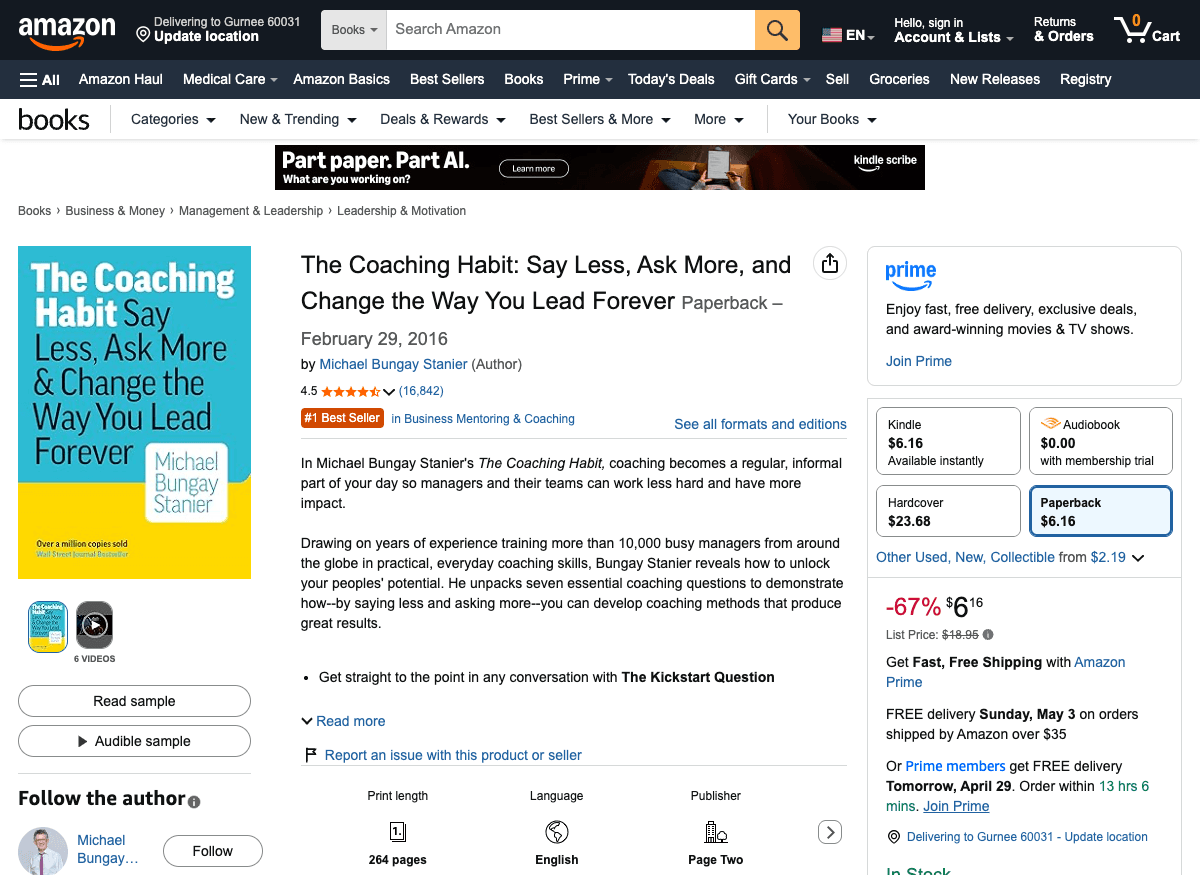
Tim Gallwey's The Inner Game of Tennis (original 1974 edition) ran around 134 pages and is the gold standard for tight methodology presentation. Michael Bungay Stanier's The Coaching Habit runs 244 pages and is the gold standard for methodology books that are also highly readable and structured around a small number of powerful tools (seven questions). Donald Miller's Building a StoryBrand runs 240 pages and follows the same pattern: one framework, enough depth to implement it, no padding.
The methodology book archetype should have a named framework. If it doesn't have a named framework, it's probably an essay collection that needs restructuring before length becomes relevant.
Archetype 3: The memoir or story-led book (220 to 320 pages)
The memoir archetype uses narrative to carry authority. This is the book that tells the story of a transformation, a career pivot, a coaching engagement, or a personal journey that shaped a professional philosophy. Brené Brown's Dare to Lead runs 320 pages. Simon Sinek's Start With Why runs 256 pages. Marshall Goldsmith's What Got You Here Won't Get You There runs 256 pages.
Ideal length: 220 to 320 pages, 6x9 trim size. Word count: 60,000 to 85,000 words.
This archetype earns its length because narrative requires time to develop. A story that pays off in 80 pages feels rushed. A leadership philosophy that lands in 320 pages of well-edited narrative has the weight to carry the credibility it is trying to build.
The memoir archetype is also the most commonly misused by coaches. Writing 300 pages of narrative is a larger creative and editorial project than most coaches have capacity for while running a practice. Coaches who attempt this archetype and finish a 200-page draft often find themselves in neither territory: too long for a lead magnet, too thin for the narrative depth readers expect from a memoir-inflected book. Be honest about capacity before committing to this archetype.
Archetype 4: The workbook (100 to 180 pages, plus exercises)
The workbook is a different animal. Pages carry exercises, reflection prompts, fill-in sections, and frameworks that the reader works through actively. Word count per page drops significantly because the page is mostly structured white space for the reader's input.
Ideal length: 100 to 180 pages, 8.5x11 trim size. Word count: 15,000 to 35,000 words of prose, with the remaining page count taken up by exercises and structured prompts.
Co-Active Coaching resources and ICF-aligned workbook formats typically run in this range. The workbook archetype is also the one where 8.5x11 trim makes sense, because the exercises need room. At 6x9, the writing lines are too narrow for comfortable use.
The archetype-to-length table
| Book archetype | Ideal page count | Word count | Trim size | Primary use |
|---|---|---|---|---|
| Lead magnet | 80 to 120 pages | 18,000 to 28,000 words | 5x8 | Discovery call funnel, low-price Amazon listing |
| Methodology book | 150 to 220 pages | 40,000 to 60,000 words | 6x9 | Core authority asset, flagship book |
| Memoir / story-led | 220 to 320 pages | 60,000 to 85,000 words | 6x9 | Narrative credibility, thought leadership |
| Workbook | 100 to 180 pages | 15,000 to 35,000 words | 8.5x11 | Client tools, companion to flagship |
How does word count translate to page count to spine width? The math, KDP-specific
This is the most concretely useful section for coaches at the production stage. The math is not complicated, but it is precise, and getting it wrong means a rejected cover or a spine that's too narrow to print text on.
The word-count-to-page-count conversion
The standard conversion for non-fiction is 250 words per page at a 6x9 trim with standard margins and a 12-point body font. This is a rough average that accounts for chapter headers, section breaks, pull quotes, and white space. It will not be exact for any individual book, but it's accurate enough for planning purposes.
For a 5x8 trim at slightly smaller margins, the conversion is closer to 230 words per page. For an 8.5x11 workbook with significant white space for exercises, assume 150 to 180 words per page of prose content.
| Trim size | Words per page (approximate) | Notes |
|---|---|---|
| 5x8 | 230 | Smaller type, tighter margins, standard non-fiction |
| 6x9 | 250 | Most common coaching and business book trim |
| 8.5x11 | 150 to 180 | Workbook format with exercise white space |
So a 50,000-word methodology book at 6x9 produces approximately 200 pages of body content. Add 10 to 15 pages of front matter (title page, copyright, dedication, table of contents) and 5 to 10 pages of back matter (about the author, resources, discovery call offer), and you're looking at 215 to 225 pages total.
How spine width is calculated
Amazon KDP Print uses the following formula for spine width:
Spine width (inches) = page count x paper thickness per page
Paper thickness varies by paper type:
- White paper (standard): 0.002347 inches per page
- Cream paper (most common for coaching books): 0.0025 inches per page
- Color paper: 0.002347 inches per page (same as white)
KDP also adds a fixed tolerance value to this formula, and the exact calculation is available on the KDP cover calculator page. The tables below give you the outputs for the page counts most relevant to coaching books, using both white and cream paper.
Spine width table: cream paper (most common for coaching books)
Cream paper is warmer in tone and often preferred for non-fiction and coaching books. It also produces a slightly wider spine than white paper at the same page count.
| Page count | Spine width (inches) | Spine width (mm) | Can text fit on spine? |
|---|---|---|---|
| 80 pages | 0.200 in | 5.1 mm | Marginal for small text |
| 100 pages | 0.250 in | 6.4 mm | Yes, small text |
| 120 pages | 0.300 in | 7.6 mm | Yes, small text |
| 150 pages | 0.375 in | 9.5 mm | Yes, standard |
| 180 pages | 0.450 in | 11.4 mm | Yes, comfortable |
| 200 pages | 0.500 in | 12.7 mm | Yes, comfortable |
| 220 pages | 0.550 in | 14.0 mm | Yes, comfortable |
| 250 pages | 0.625 in | 15.9 mm | Yes, comfortable |
| 280 pages | 0.700 in | 17.8 mm | Yes, comfortable |
| 320 pages | 0.800 in | 20.3 mm | Yes, generous |
Spine width table: white paper
White paper produces a thinner spine at the same page count. Methodology books with diagrams or visual elements often use white paper for better image reproduction.
| Page count | Spine width (inches) | Spine width (mm) | Can text fit on spine? |
|---|---|---|---|
| 80 pages | 0.188 in | 4.8 mm | Marginal |
| 100 pages | 0.235 in | 6.0 mm | Yes, very small text |
| 120 pages | 0.282 in | 7.2 mm | Yes, small text |
| 150 pages | 0.352 in | 8.9 mm | Yes, standard |
| 180 pages | 0.423 in | 10.7 mm | Yes, comfortable |
| 200 pages | 0.470 in | 11.9 mm | Yes, comfortable |
| 220 pages | 0.517 in | 13.1 mm | Yes, comfortable |
| 250 pages | 0.587 in | 14.9 mm | Yes, comfortable |
| 280 pages | 0.657 in | 16.7 mm | Yes, comfortable |
| 320 pages | 0.751 in | 19.1 mm | Yes, generous |
Note: these figures use KDP's published paper thickness values (cream: 0.0025 in/page, white: 0.002347 in/page) plus a 0.06-inch fixed tolerance for the cover wrap. Verify against the KDP cover calculator for your specific trim size before submitting your cover file.
Why cream paper produces a wider spine
The difference between 0.0025 and 0.002347 per page sounds tiny but accumulates over 200 pages. At 200 pages, cream paper adds 0.03 inches of spine width compared to white. At 300 pages, the difference is 0.045 inches. Not enough to change your book's archetype, but enough to matter for spine text sizing. If you're on the narrow edge of fitting a title on the spine, switching from white to cream paper may be the simplest fix.
What's the right workflow for picking your length and locking it before drafting?
Most coaches make the length decision too late. They draft, reach 40,000 words, look up the KDP spine math, and discover the page count produces a spine too narrow for the cover they've already commissioned. This is an avoidable problem if length is decided before drafting begins.
The workflow has four steps.
Step 1: Identify your archetype
Answer these questions in order:
"What is this book's primary job?" If the answer is generating discovery calls or email subscribers, lead magnet. If the answer is codifying your coaching system so clients and peers can learn it, methodology book. If the answer is telling a formative story that carries your philosophy, memoir-led. If the answer is giving clients a structured tool to work through, workbook.
If the answer is "all of the above," pick the one that matters most. A book that tries to be a lead magnet and a methodology book and a workbook is usually none of them effectively.
Step 2: Set a target page count from the archetype table
Use the archetype-to-length table in the section above. Set a specific number, not a range. "About 180 pages" becomes a harder target than "150 to 220," and a harder target produces a better book because it forces editorial decisions rather than allowing indefinite expansion.
A useful forcing question: "If this book were 30 pages shorter, what would I cut first?" If the answer comes easily, cut those pages before drafting. If the answer is "nothing, every page is essential," the target page count is probably right.
Step 3: Back into word count
Apply the conversion table above for your trim size. For most coaching books at 6x9, multiply your target page count by 250 to get a target word count.
Example: a methodology book targeting 180 pages at 6x9 needs approximately 45,000 words of body content, plus 10 to 15 pages of front and back matter (not part of body word count).
Write the target word count on a piece of paper and put it where you write. A word count target is not a cage. It's a guide rail that keeps the book on course.
Step 4: Calculate the spine width before commissioning the cover
Run the numbers using the table in the section above before contacting a cover designer or generating a cover in any tool. Cover designers need the spine width measurement to set up the file. If you give them the wrong number, the cover file will need to be rebuilt.
Built&Written calculates spine width automatically from your page count and paper type selection. If you're using Atticus or another formatting tool, you'll need to calculate it manually using the tables above or the KDP cover calculator.

How does KDP's spine math actually work, and what triggers cover rejection?
The KDP spine math is mechanical and unforgiving. Submit a cover file with the wrong spine width and KDP returns an error. Submit one that's close but slightly off and the automated system may catch it at upload or the physical proof copy will show text that runs off the spine edge.
Understanding how KDP builds the spine calculation tells you exactly which decisions in the drafting and formatting process affect the cover, and why locking page count before commissioning a cover is not optional.
How KDP calculates the spine width
Amazon KDP's cover calculator uses this formula:
Total cover width = (trim width x 2) + bleed (0.125 in each side x 2) + spine width
Spine width = (page count x paper thickness) + 0.06 inches (cover wrap tolerance)
The 0.06-inch fixed tolerance is constant across all trim sizes and paper types. It accounts for the cover's own material thickness wrapping around the spine. The page count x paper thickness calculation is what varies.
The formula is simple. The mistake coaches make is running it against a wrong page count. Page count is the final print page count, not the manuscript word count divided by 250. The final print page count includes:
- All front matter pages (title page, copyright, dedication, table of contents, foreword, acknowledgments)
- All body pages
- All back matter pages (about the author, resources, bibliography, index if applicable, blank end pages)
- Any intentionally blank pages inserted for right-left page balance
Front and back matter typically add 15 to 25 pages to a coaching book. Budget for this before you run the spine math.

What triggers a KDP cover rejection
KDP rejects cover files for four spine-related reasons:
First, the spine width in the file does not match the expected width for the declared page count and paper type. This is the most common. It happens when the page count changes after the cover was designed.
Second, the spine width is correct but the cover dimensions are wrong. Total cover width (back + spine + front + bleed) must match KDP's calculated value exactly, within a 0.0625-inch tolerance.
Third, text or design elements on the spine are too close to the spine edge. KDP requires a 0.0625-inch buffer inside each spine edge before any text or design element begins. On a 200-page cream-paper book, the spine is 0.5 inches wide. Subtract 0.125 inches total for the two edge buffers, and you have 0.375 inches for spine content. A book title in a readable font needs at least 0.25 inches of spine width to display legibly. This is why books under 100 pages have spines that can't carry text.
Fourth, the cover file is submitted at the wrong resolution. KDP requires 300 DPI minimum for print covers. This is not a spine-specific rule but it's the fourth most common rejection reason.
The minimum spine width for readable text
KDP does not specify a minimum spine width for text, but the practical minimum for a legible title in a standard font is approximately 0.25 inches (6.4 mm) of usable spine space after the edge buffers. This corresponds to roughly:
- White paper: 135 to 145 pages
- Cream paper: 115 to 125 pages
Books below these thresholds can still have a spine, but the spine will be blank or carry only a small design element. If your lead magnet runs 80 to 100 pages, plan for a front-cover-focused design with no spine text. If the book will primarily be a Kindle download, this is not a problem. If it will be displayed on a physical shelf, it is.
The page count lock rule
Here is the operational rule that prevents cover rejections: lock your page count before commissioning your cover. Not approximately. Exactly.
"Approximately 200 pages" is not a locked page count. After formatting, front matter, and back matter are added, a 200-page estimate can easily become 214 pages. The cover file designed for 200 pages has a spine width of 0.5 inches (cream) or 0.470 inches (white). The spine width for 214 pages is 0.535 inches (cream) or 0.502 inches (white). The cover needs to be rebuilt.
Format the interior first. Count the final pages. Then commission or generate the cover. In that order.
What do bestselling coaching books actually look like in terms of page count?
Data from the books that coaches most often cite as models. These are not aspirational targets. They are calibration points for understanding what works at various lengths.

| Book | Author | Pages | Trim (approx) | Archetype | Notes |
|---|---|---|---|---|---|
| Atomic Habits | James Clear | 320 | 5.5x8.5 | Methodology | Upper boundary; edited aggressively [verify] |
| Dare to Lead | Brené Brown | 320 | 6x9 | Methodology / memoir | Research-heavy; narrative framework |
| Start With Why | Simon Sinek | 256 | 5.5x8.5 | Methodology | Single-idea book expanded to book length |
| What Got You Here Won't Get You There | Marshall Goldsmith | 256 | 5.5x8.5 | Methodology | Structured around 20 habits; evidence-based |
| Building a StoryBrand | Donald Miller | 240 | 6x9 | Methodology | Framework-first; highly replicable structure |
| The Coaching Habit | Michael Bungay Stanier | 244 | 5.5x8.5 | Methodology | 7-question framework; highly readable |
| The Miracle Morning | Hal Elrod | 176 | 5.5x8.5 | Methodology / lead-gen | Upper lead magnet range |
| The Inner Game of Tennis | Tim Gallwey | 134 | 5.5x8.5 | Methodology | Gold standard for tight methodology; no padding |
*All page counts from published Amazon listings. Trim sizes are approximate. *

The pattern across these books is consistent: the best-regarded books in the coaching and business category run 134 to 320 pages, with the majority clustering between 176 and 280 pages. No book in this set runs to 400 pages. This is not because coaches and business authors run out of content. It's because editors cut content that dilutes the central argument.
The lesson for coaches: if your methodology book is approaching 350 pages, it's not thorough. It's unedited.

From length decision to KDP upload: a coach's length-and-format checklist
This checklist runs in order. Do not skip to Step 4 without completing Steps 1 through 3.
Step 1: Choose your archetype
- Lead magnet: book's job is to generate discovery calls or email subscribers. Target 80 to 120 pages.
- Methodology book: book's job is to codify your system. Target 150 to 220 pages.
- Memoir / story-led: book's job is narrative authority. Target 220 to 320 pages.
- Workbook: book's job is structured client use. Target 100 to 180 pages at 8.5x11.
If you cannot choose, your book does not have a clear enough purpose. Fix that before choosing a page count.
Step 2: Set a target page count
Apply the archetype table. Pick a specific number. Write it down.
Useful sanity check: look at the bestseller table above. Find the book in that table whose job most closely matches yours. That book's page count is a reasonable target.
Step 3: Back into word count
Multiply your target page count by the words-per-page conversion for your trim size (230 for 5x8, 250 for 6x9, 150 to 180 for 8.5x11). Subtract 15 to 25 pages for front and back matter before calculating. Example: 180-page methodology book at 6x9, minus 20 pages for front/back matter = 160 pages of body content x 250 words = 40,000 words.
Step 4: Calculate your spine width
Use the tables in the section above or the KDP cover calculator. Choose your paper type (cream is the default for most coaching books). Note the exact spine width in inches. This is the number your cover designer or cover tool needs.
If using Built&Written, this step is automatic. The tool calculates spine width from your final page count and paper selection.
Step 5: Format the interior first, commission the cover second
Format your interior manuscript. Count the final page count including all front and back matter. Verify that the final page count matches your target from Step 2. If it doesn't, adjust either the content or the trim size before generating the cover.
For formatting tools: Built&Written exports a KDP-ready PDF from the wizard. Atticus produces KDP-ready output from a formatted manuscript. Both are reviewed in depth in our formatting tools comparison for coaches.
Step 6: Verify the three production specs before cover submission
Three numbers must be confirmed before you submit a cover file to KDP:
- Final page count (from formatted interior, including all front and back matter)
- Trim size (locked, not "probably 6x9")
- Paper type (cream or white, not "whatever the default is")
Run these three numbers through the KDP cover calculator for the final spine width confirmation. This takes four minutes. It prevents a cover rejection.
Step 7: Order a physical proof copy before launch
Before going live, order one physical proof copy from Amazon KDP Print. Read it. Check:
- Spine text is fully visible and not cut off at the edge
- Interior margins are correct (no text too close to the gutter)
- Images, if any, are at 300 DPI and not pixelated
- Front and back cover art looks correct in physical form, not just on screen
The proof copy costs approximately $4 to $8 for a standard coaching book plus shipping. It saves you from discovering the print problem after the book is live.
Ready to start? Built&Written's free trial gets you into the length decision, content assembly, and KDP-ready export in one workflow. No manual spine math required.
The verdict: how long should YOUR coaching book be?
The verdict is by archetype. Find yours in the table below.
| Your situation | Archetype | Target length | Expected spine (cream, 6x9) |
|---|---|---|---|
| Building a discovery call funnel with a low-barrier book | Lead magnet | 80 to 120 pages | 0.200 to 0.300 in |
| Codifying your core coaching system or framework | Methodology book | 150 to 220 pages | 0.375 to 0.550 in |
| Telling the story that explains your philosophy | Memoir / story-led | 220 to 320 pages | 0.550 to 0.800 in |
| Creating a structured tool clients use during engagements | Workbook | 100 to 180 pages (8.5x11) | Wider trim, different math |
The honest answer for most coaches building a first book: the methodology book archetype at 150 to 200 pages is the most achievable, the most credible, and the most commercially effective starting point. It's long enough to develop a framework with depth, short enough to be readable in a weekend, and it produces a spine wide enough to carry your name and title on a bookshelf.
Coaches who try to write the 320-page memoir on the first book often don't finish it. Coaches who try to make the lead magnet do the work of the methodology book (by stuffing 50,000 words into a 90-page format) create a book that is either too dense to read or too light to trust.
The books in the bestseller table above are models, not targets. James Clear's Atomic Habits at 320 pages is not a target to match. It's a ceiling to understand. Tim Gallwey's The Inner Game of Tennis at 134 pages is not a floor. It's a proof point that tight, short books can carry enormous authority.
Your book's length is the length it takes to do its job without padding. That's the metric. Not "how long is a real book?" Not "how long were the books I admire?" How long does your specific job require?
Identify the job. Pick the archetype. Apply the math. Lock the page count before the cover. Publish.
For a step-by-step guide to the full publishing process once length is decided, see the complete coach's guide to AI book writing and publishing and how to self-publish a coaching book on Amazon KDP.
Key takeaways
- "How long should my book be?" is the wrong first question. The right first question is "what job is this book doing?"
- Four archetypes, four length targets: lead magnet (80 to 120 pages), methodology book (150 to 220 pages), memoir/story-led (220 to 320 pages), workbook (100 to 180 pages at 8.5x11).
- Spine width is calculated by multiplying final page count by paper thickness per page, then adding a 0.06-inch fixed tolerance. Cream paper (0.0025 in/page) produces a slightly wider spine than white paper (0.002347 in/page) at the same page count.
- Lock page count before commissioning a cover. Changing the page count after the cover is designed means rebuilding the cover file.
- Books under 115 to 135 pages (depending on paper type) may not have enough spine width for readable title text. Plan accordingly for physical display.
- The bestselling coaching and business books cluster between 134 and 320 pages, with the majority between 176 and 280 pages. The lesson: no methodology book needs 400 pages.
- KDP cover rejections for spine-related reasons are almost entirely preventable by running the spine math against the final formatted page count before submitting.
- Built&Written calculates spine width automatically. Every other major tool requires manual calculation.
Frequently asked questions
How long should a coaching book be if I want to use it as a lead magnet?
80 to 120 pages is the target range for a coaching book used primarily as a lead magnet. At 5x8 trim, this runs approximately 18,000 to 28,000 words. Long enough to be substantive, short enough to be read completely before the reader makes a decision about working with you. Hal Elrod's The Miracle Morning at 176 pages sits at the upper boundary of what functions as a lead magnet. Most coaches should aim for the tighter end of the range.
What is the minimum page count for a spine to be printable on Amazon KDP?
KDP does not publish a hard minimum, but the practical minimum for readable spine text is approximately 100 to 130 pages depending on paper type. On cream paper, 100 pages produces a 0.25-inch spine (6.4 mm). After the required 0.0625-inch buffer on each edge, you have approximately 0.125 inches of usable spine width. This is marginal for any text but possible for a small logo or design element. For a full title and author name in a legible size, 150 pages is a more reliable minimum.
How do I calculate the spine width for my KDP book without using Built&Written?
Use the KDP cover calculator and enter your trim size, paper type, and final page count. Alternatively, use the spine width tables in this article: multiply your page count by 0.0025 (cream paper) or 0.002347 (white paper), then add 0.06 inches. The result is your spine width in inches. Round to four decimal places when communicating the measurement to a cover designer.
Is 50,000 words enough for a coaching book?
Yes, for a methodology book. 50,000 words at 6x9 trim produces approximately 200 pages of body content, which sits in the middle of the methodology book range. This is roughly the length of Building a StoryBrand by Donald Miller and slightly longer than The Coaching Habit by Michael Bungay Stanier. Both books are considered authoritative in the coaching category. 50,000 words is more than enough if the content is well-edited.
Does Amazon KDP reject books that are too short?
Not for length alone. Amazon KDP's content guidelines do not specify a minimum page count. However, KDP has policies against "content that does not provide an acceptable reading experience," and extremely short books (under 24 pages for print books) can be flagged. For print books, the minimum page count KDP will accept is 24 pages. For a coaching book of any archetype, this is not a practical constraint.
How does paper type (cream vs white) affect spine width?
Cream paper is slightly thicker per page than white paper: 0.0025 inches per page versus 0.002347 inches per page. The difference is small but accumulates. At 200 pages, cream paper produces a spine of 0.560 inches (including the 0.06-inch tolerance) compared to 0.530 inches for white paper. At 300 pages, the difference grows to 0.810 inches versus 0.764 inches. For most coaching books, cream paper is preferred for aesthetic reasons (warmer tone, easier on the eyes for long reading) and the slightly wider spine is a secondary benefit.
Can I change the trim size after formatting to get a different page count?
Yes, but it changes the page count and therefore the spine width, and any commissioned cover needs to be rebuilt. If you're using Built&Written or a comparable tool that handles both interior formatting and cover generation, changing the trim size is straightforward. If you've commissioned a cover from a designer separately, changing trim size means a new cover brief and a rebuild. Do the trim size decision before any cover work begins.
Sources and references
Sources & References
- https://kdp.amazon.com/help/topic/G201834180
- https://kdp.amazon.com/cover-calculator
- https://kdp.amazon.com/en_US/help/topic/G200672390
- https://www.builtwritten.com/
- https://www.atticus.io
- https://coachingfederation.org/research
- https://www.boxofcrayons.com/the-coaching-habit-book/
- https://storybrand.com
- https://author.amazon.com
About the author

Michael Pavlovskyi
Connect on LinkedInReady to write your book?
Turn your expertise into a professional book with Built&Written.
Put your book on the page